


Data-Driven Breakthroughs
The process of bringing a new drug to market has never been straightforward. It takes an average of ten to fifteen years, billions of dollars in investment, and countless rounds of testing before a single treatment reaches the people who need it.
That reality is beginning to shift. AI in drug discovery is changing how companies identify, develop, and validate new compounds, moving the industry toward a model that is faster, more precise and far better equipped to meet the scale of global health challenges.
A New Era for Pharmaceutical Research
For most of modern medicine’s history, drug discovery depended on scientific intuition, physical experimentation and time. Researchers would manually screen thousands of chemical compounds searching for molecules capable of interacting with a disease target. Progress was slow and outcomes were rarely guaranteed.
Years of careful experimentation could lead nowhere, and even promising candidates would often fail without a clear explanation. That has changed. Machines now work through biological and chemical datasets at a scale that earlier researchers never could have imagined. No manual team could keep up with that speed, let alone match its consistency.
How the Technology Actually Works
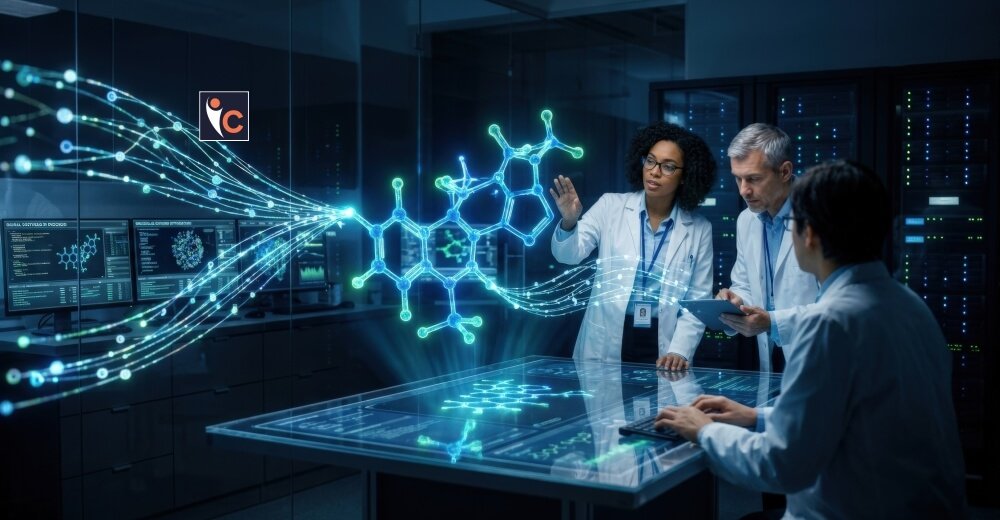
Modern drug discovery relies on machine learning models trained across enormous collections of molecular data, protein structures, genomic sequences, and clinical records. These models evaluate how a compound is likely to behave inside the body, which biological targets it may bind to, and what risks it could carry, before any physical testing begins.
Beyond analysis, generative tools can now propose entirely new molecular structures designed around specific biological targets rather than selected from existing compound libraries. This moves the field from a search-based approach to a design-based one, a meaningful shift in how early-stage research gets done and how quickly viable candidates can be identified. AI in drug discovery makes this level of precision possible at a scale the industry has never seen before.
Reducing Failure Rates at Every Stage
Among the most valuable contributions of AI in drug discovery is its capacity to lower the rate at which drug candidates fail during development. The historical failure rate for compounds entering clinical trials sits above ninety percent. A significant portion of those failures traces back to toxicity or efficacy problems that were not identified early enough.
Predictive models built on decades of trial data can surface these concerns before development reaches its costliest phases, helping pharmaceutical companies concentrate their resources on the candidates with the strongest profiles. Identifying problems early not only preserves the budget. It preserves time, which in medicine is rarely a resource that can be recovered once lost.
Real-World Applications Already Underway
AI in drug discovery is already generating tangible outcomes. Machine-learning-designed molecules have entered clinical trials across oncology, infectious disease, and rare genetic conditions. Organizations built around data-driven development have established themselves as credible forces in the pharmaceutical sector, drawing investment and forming partnerships with some of the industry’s most established names.
The applications extend beyond molecule design. These technologies are being used to find new uses for already-approved drugs, pinpoint patient groups most likely to benefit from specific treatments, and produce evidence that supports regulatory review. Each application of AI in drug discovery brings the gap between discovery and patient benefit a step closer to closing.
The Role of Data in Driving Discovery
Progress of this kind depends entirely on data, and the pharmaceutical industry holds an extensive record of it. Trial documentation, genomic research, clinical observations, and compound testing histories represent a body of knowledge that was long too large and too fragmented to use with any real efficiency.
AI in drug discovery draws meaning from that accumulated record, identifying connections and patterns that would be beyond the reach of any individual research effort. As institutions become more willing to share data across collaborative networks and regulators grow more comfortable with computationally supported submissions, the underlying models will become sharper and more dependable over time.
Drug Discovery and Its Meaning for Patients
Every development in pharmaceutical research ultimately comes down to its effect on patients. AI in drug discovery is beginning to produce that effect in concrete ways. Shorter development cycles mean effective treatments become available sooner. Stronger candidate selection means fewer costly failures and more efficient use of resources, which over time can support broader access across different populations and geographies.
The capacity to pursue therapies for rare conditions, areas where traditional development models rarely justify the investment, represents one of the more significant shifts this technology enables. People who previously had no viable treatment path are beginning to find one.
Looking Ahead
AI in drug discovery remains a field with considerable room still to grow. Regulatory thinking is evolving, scientific methods are advancing, and the working relationship between data science and pharmaceutical research is becoming more integrated with each passing year.
One thing is clear and this is not an incremental improvement on an existing process. It represents a different way of approaching the challenge of developing medicine altogether. The treatments that emerge over the next decade will reflect the possibilities unlocked when human expertise and intelligent systems work in genuine collaboration toward the same goal.