



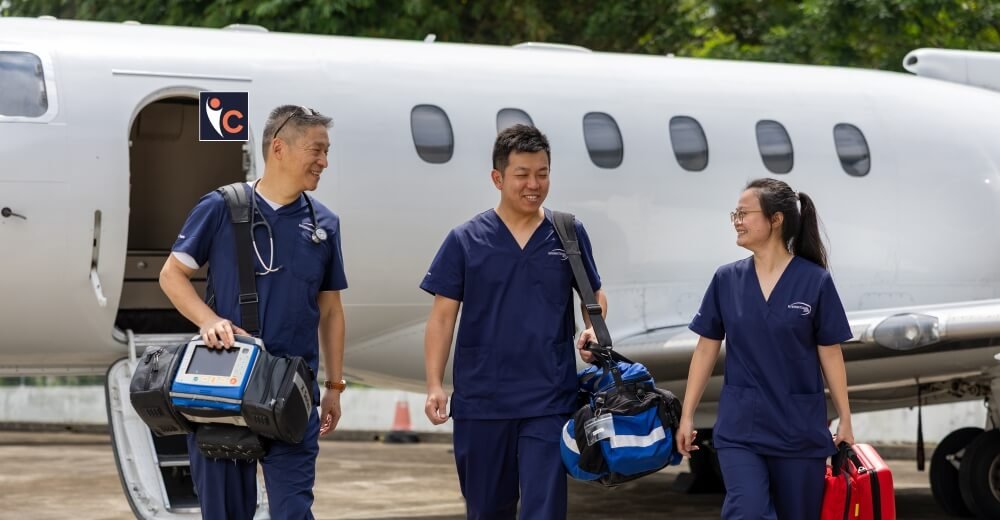
Aviation medical assistance is called upon when travel takes an unexpected turn. When illness or injury strikes far from home, decisions must be made quickly, often across borders, with little room for error. In these moments, the work is less about logistics and more about people, their safety, dignity, and the families waiting for them.
In the aviation medical assistance industry, meaning is often found not in visibility, but in moments of humanity. For Christina Hah, General Manager, Assistance, Southeast Asia, at International SOS, such moments define both her leadership and the purpose behind her work.
One recent case remains vivid. A father on holiday in Penang fell critically ill, and local medical options were quickly exhausted. His condition worsened rapidly, and doctors believed he had only days, perhaps hours, to live. His final wish was to return home to spend his remaining time with his family.
The situation demanded immediate action across borders and under intense emotional pressure. Christina recalls how the team mobilised within hours to coordinate an overland ambulance transfer across countries. Regulatory approvals, medical stabilisation, and logistics had to come together seamlessly. The route was not the most convenient, but it was the one that respected the patient’s dignity.
Reflecting on the case, Christina says, “In medical assistance, the right decision is not always the easiest one, but it must always be the most compassionate.” That belief continues to guide how her teams operate, especially when time is limited and the stakes are high.
Let’s explore how aviation medical services combine innovation, compassion, and global readiness to save lives and support travellers worldwide!
Leading at the Intersection of Care and Complexity
As General Manager for Assistance in Southeast Asia, Christina oversees some of International SOS’s most complex medical assistance operations. Her responsibilities include aviation medical services, emergency evacuations, and crisis response across a region defined by diversity in healthcare systems, infrastructure, language, and regulation.
Her role requires constant coordination with emergency-trained physicians, operations specialists, aviation partners, and local healthcare providers. No two cases are alike. From skiing accidents in Japan to neonatal evacuations from Southeast Asia, each mission demands a tailored approach.
Christina often reminds her teams that leadership in this space goes beyond execution. “Every evacuation represents a person and a family at one of the most vulnerable moments of their lives,” she explains. “We never allow the process to overshadow the human reality.”
This perspective shapes decision-making across her teams, reinforcing the importance of empathy alongside clinical precision.
How the Industry Has Evolved
Over more than four decades, International SOS has evolved alongside the aviation medical assistance industry. What began as a focus on medical transportation has expanded into a broader role as a strategic partner supporting governments, multinational organisations, insurers, and individual travellers.
Today, aviation medical services extend far beyond illness or injury. Crisis-triggered extractions have become increasingly common, driven by political unrest, natural disasters, armed conflict, and civil instability. Christina points to recent responses during flooding in Manila, evacuations from conflict-affected regions in the Middle East, and periods of heightened border tension in Southeast Asia as examples of this shift. “Our work now sits at the intersection of medical, security, and logistical risk,” she says. “You cannot treat these elements in isolation anymore.”
What distinguishes International SOS in this evolving environment is its ability to integrate scale with local insight. With more than 13,000 medical, security, logistics, and digital experts operating across 1,200 locations in 90 countries, the organisation can coordinate across borders in real time. Christina notes that while global reach enables response, outcomes depend on people. “Technology and infrastructure create capability,” she says, “but it is our teams who deliver care.”
Changing Expectations and Patient Profiles
The past five years have reshaped the aviation medical assistance sector in fundamental ways. The COVID-19 pandemic accelerated expectations around healthcare access during travel and heightened awareness of infectious disease risk. At the same time, climate volatility, geopolitical instability, and the return of international travel have increased complexity.
Christina has also observed a clear shift in patient demographics. As global workforces age, acute medical events during travel have become more common. Many travellers now move internationally with chronic conditions, multiple medications, and reduced tolerance for disruption. “The profile of the travelling patient has changed,” she explains. “Our teams must be ready not only for physical emergencies, but also for emotional stress and uncertainty.”
In response, International SOS has strengthened training across trauma care, chronic condition management, and palliative support. Christina emphasises that aviation medical assistance today must account for both clinical urgency and emotional resilience.
Technology as an Enabler of Better Decisions
Technology has become central to how International SOS delivers modern medical assistance. In 2025, the organisation launched Quantum, an integrated Travel and Critical Event Management platform that centralises intelligence, communication, and operational workflows.
Christina describes Quantum as a single source of truth. “It allows us to see where travellers are, understand what risks they face, and respond immediately,” she says. During an emergency call, travellers can be geolocated instantly, local risks assessed, and support activated without delay.
She recalls a recent typhoon response where Quantum enabled teams to send proactive alerts, identify affected travellers, confirm their safety, and begin evacuation planning in under an hour. “Speed matters in a crisis,” she notes, “but clarity matters just as much.”
Innovation is also extending into in-flight care. In a recent trial, patient vital signs were transmitted mid-flight to medical directors on the ground, enabling receiving hospitals to prepare in advance. While still under development, Christina views this as a natural progression. “Technology should never replace clinical judgement,” she says, “but it should strengthen it.”
The Reality Behind Medical Evacuations
Medical evacuations are often imagined as dramatic air ambulance flights. Christina is quick to clarify that reality is far more nuanced. Every evacuation decision is guided by a structured triage process that balances medical urgency, safety, cost considerations, and patient dignity.
The process begins with consultation, either with the patient or the attending physician. International SOS doctors assess mobility, condition severity, comorbidities, and medication needs. Based on this assessment, the most appropriate transport solution is selected, which may include a commercial flight with medical escort, stretcher configuration, business class seating, or an air ambulance.
Funding plays a critical role. Christina explains that patients may be covered by employer insurance, private insurance, or personal funds. For self-funded cases, stabilisation options may allow safer and more cost-effective transport. “The best evacuation is not always the most expensive one,” she says. “It is the one that is medically appropriate and financially responsible.”
Operating Across Southeast Asia
Southeast Asia presents unique operational challenges for aviation medical services. The region’s diversity requires more than logistical expertise. It demands cultural intelligence and strong relationships.
Christina highlights the importance of close collaboration with airlines, airports, immigration authorities, and healthcare providers. Whether reconfiguring aircraft cabins for stretcher placement or securing emergency landing permissions, teams must anticipate regulatory hurdles and adapt quickly.
Beyond emergency response, International SOS supports clients proactively through pre-travel advisories, medical risk ratings, and e-learning modules. “Prevention and preparedness are as important as response,” she explains. “Duty of care begins long before an incident occurs.”
She also stresses that aviation medical services are never delivered in isolation. Every mission depends on coordination across hospitals, ground handlers, flight crews, and authorities. Partnerships with medical institutions such as KK Women’s and Children’s Hospital in Singapore enable complex neonatal transfers under shared standards of care.
Measuring Impact Through Lives Changed
Certain cases remain deeply personal for Christina. One involved a premature baby born overseas, where local medical facilities lacked the required expertise. The family wanted to return to Singapore for specialist treatment.
International SOS partnered with KK Women’s and Children’s Hospital to deploy a neonatal team and specialised equipment. Christina recalls how every detail was managed carefully, from oxygen regulation to cabin temperature. “There is no margin for error in cases like these,” she reflects.
Another case involved a patient with a spinal fracture stranded at a remote ski resort. Unable to sit upright and facing air ambulance costs beyond insurance coverage, the situation was daunting. The team stabilised the patient locally and arranged a stretcher configuration on a commercial flight two days later. “The outcome mattered not only medically,” she says, “but financially and emotionally for the family as well.”
Looking Ahead
Christina sees several trends shaping the future of aviation medical assistance. Climate-related events are becoming more frequent and severe, disrupting travel and increasing demand for rapid response. An ageing global workforce will require stronger chronic care and escort services. Digital expectations will continue to rise, with clients seeking transparency and real-time updates. Geopolitical tensions may also drive more politically motivated evacuations.
“Resilience will not come from technology alone,” she says. “It will come from integrating people, process, and platforms into a cohesive system.”
A Call for Preparedness and Partnership
For leaders across aviation, healthcare, and global mobility, Christina offers a clear message. Organisations must recognise their limitations and seek trusted partners where gaps exist. International SOS, she explains, aims to act as an extension of client teams rather than a replacement.
“Reactive models are no longer sufficient,” she says. “The future of aviation medical services lies in proactive, integrated, and human-centred care.”
In an industry defined by urgency and uncertainty, International SOS continues to redefine aviation medical services by anchoring innovation in compassion and global reach in human connection.