

Critical Transport Solutions
There are medical situations where the distance between a patient and the care they need is not just an inconvenience; it is a matter of survival. Road transport has limits. Geography creates barriers. And in the most serious cases, the time it takes to reach definitive medical care directly shapes the outcome. This is the reality that makes flight medical support one of the most critical functions in modern emergency and critical care medicine. It bridges the gap between where a patient is and where they need to be, while keeping them alive and as stable as possible along the way.
The Specialized Care Behind Air Medical Transport
Flight medical support is considerably more than transportation with a medical professional on board. It is a highly specialized form of patient care delivered in one of the most challenging environments medicine operates in, a moving aircraft with limited space, ambient noise, pressure changes, and the constant demands of monitoring and managing a critically ill or injured patient far from the resources of a hospital setting.
The teams providing this care are trained specifically for the unique demands of the flight environment. They bring advanced clinical skills, specialized equipment, and the ability to make complex medical decisions independently, often without the ability to quickly consult with additional specialists or access the full resources of a hospital facility.
Bridging the Distance to Specialized Medical Care
Air medical support serves patients across a wide range of situations. Trauma patients in remote locations need rapid transport to trauma centers equipped to manage their injuries. Critically ill patients in smaller facilities need transfer to hospitals with the specialist capabilities their condition requires. Patients in geographically isolated communities need access to care that simply is not available locally.
In each of these situations, the flight medical team is not just a transport service; they are an extension of the hospital care environment, maintaining or improving the patient’s condition during a journey that road transport could not complete quickly enough to make a meaningful difference.
Managing Complex Care During Air Transport
Providing medical care in an aircraft introduces challenges that do not exist on the ground. Altitude affects how the body responds to certain conditions and how some medications behave. Cabin pressure, temperature, and noise all create variables that the medical team must account for. Space constraints limit what equipment can be brought and how interventions can be performed.
Strong flight medical support is built around training and preparation that accounts for all of these variables. Clinicians working in this environment develop the specific competencies needed to deliver safe and effective care under conditions that differ meaningfully from ground-based emergency medicine. That specialized preparation is what makes it possible to care for critically ill patients in an environment that was not designed for medicine.
Medical Equipment Built for Air Transport
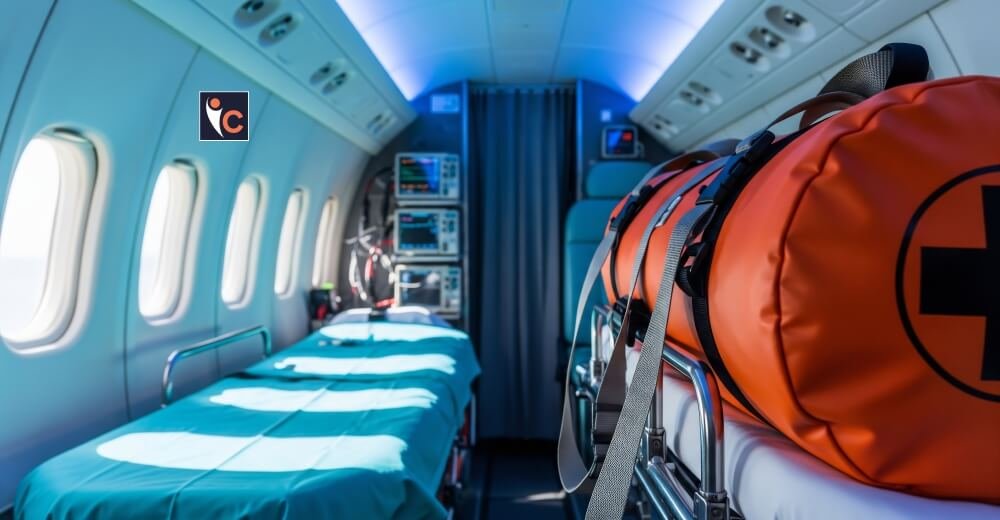
The equipment used in flight medical support is selected and designed with the constraints of the flight environment in mind. It needs to be compact, lightweight, and capable of functioning reliably under the conditions of flight. Monitoring systems, ventilators, medication delivery devices, and diagnostic tools all need to perform consistently in an environment where failures carry consequences that are difficult to manage and impossible to quickly reverse.
The ongoing development of flight-compatible medical equipment has significantly expanded what is clinically achievable during transport, allowing more complex patients to be safely moved over longer distances than was previously practical.
Coordination as a Core Competency
Flight medical support does not begin when the aircraft lifts off and ends when it lands. It is embedded in a broader coordination system that starts before departure and continues through to handover at the receiving facility. Communication between the sending facility, the flight team, and the receiving hospital ensures that every party has the information they need and that the transition of care happens with continuity rather than disruption.
This coordination is one of the less visible but genuinely important dimensions of effective critical care transport. A technically excellent in-flight clinical team operating within a poorly coordinated system will produce worse outcomes than a well-integrated team working within a structure designed to support seamless transitions at every stage of the transport process.
Delivering Compassion Alongside Critical Care
Behind every critical care transport is a patient and a family in one of the most frightening moments of their lives. The clinical priorities of flight medical support are clear: stabilize, monitor, intervene as needed, and deliver the patient safely to a higher level of care. But the human dimension of that work carries weight too.
Flight medical teams often interact briefly with family members at the point of departure, and the professionalism, calm, and competence they project in those moments matter to the people watching a loved one being loaded onto an aircraft under urgent circumstances. That human element does not distract from the clinical work; it is part of delivering genuinely good care.
In Summary
The clearest measure of what flight medical support contributes to critical care medicine is found in the outcomes of patients who received it, patients who survived conditions and injuries that geography and distance would otherwise have made fatal. Access to rapid, high-quality aeromedical transport has extended the reach of specialist medical care in ways that have changed survival statistics for serious trauma and critical illness.
As aircraft capabilities, medical equipment, and clinical training all continue to advance, the role of flight medical support in the broader critical care system will only become more significant, reaching more patients in more situations and continuing to close the gap between where serious illness strikes and where the care to address it lives.