

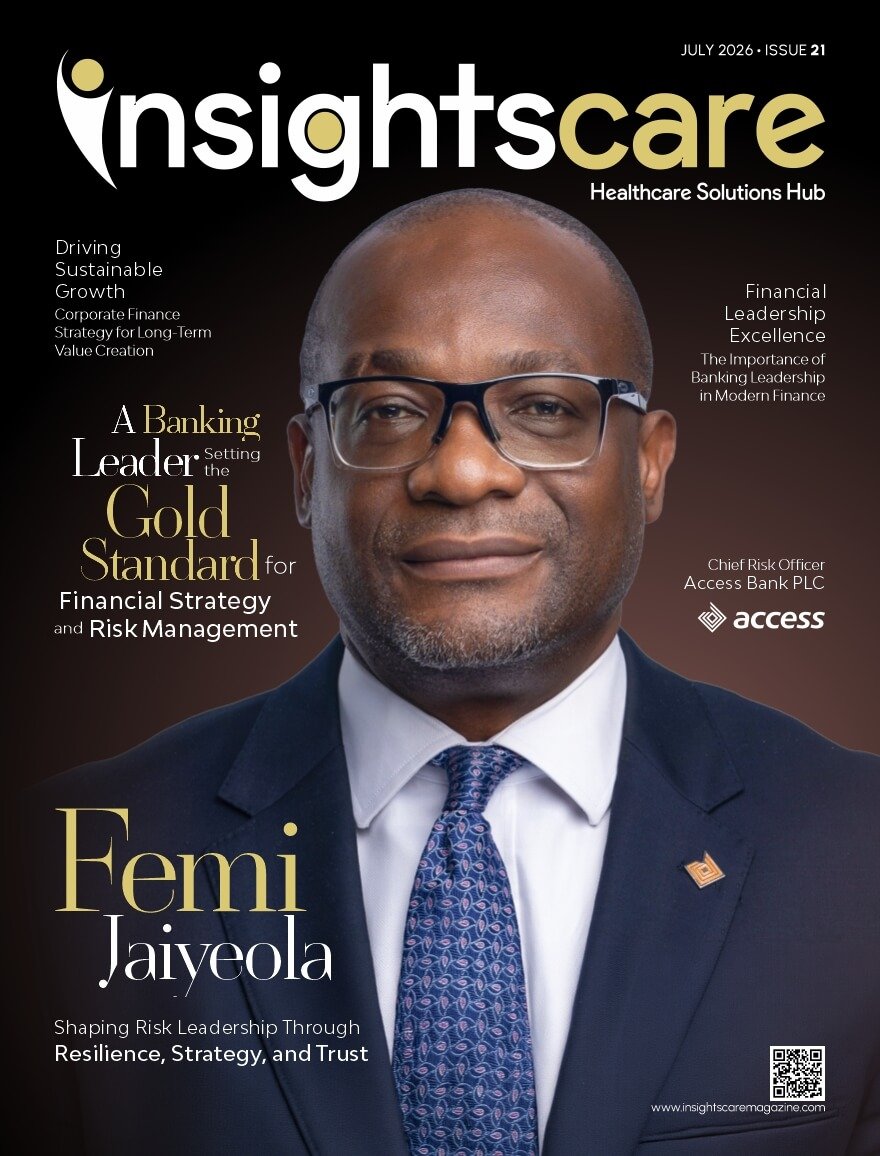

Risk management in banking has become one of the most important disciplines in modern finance. As institutions grow larger, markets grow more unpredictable, and regulatory scrutiny intensifies, the professionals carrying that responsibility must evolve alongside it. The role today is very different from what it was a decade ago.
That shift has moved risk leadership into a fundamentally different space. It is no longer enough to understand frameworks and compliance requirements. Today, risk leaders are expected to play an active role in strategic decision-making and challenge assumptions at the highest levels. They are also responsible for building cultures where sound judgment becomes part of everyday decision-making across the entire organisation, not just within specific departments.
Femi Jaiyeola has built his career at the centre of that shift. As Chief Risk Officer at Access Bank PLC, he holds one of the most demanding roles in the industry. His background spans consulting, operations, internal audit, compliance, and risk management, shaped through years of experience. That breadth of experience gave him something many specialists take years to develop: a practical understanding of how every layer of a banking institution connects and operates together.
What stands out about his approach is where he places his focus. Beyond governance structures and risk frameworks, he has invested significantly in people, team development, organisational culture, and the kind of institutional thinking that continues beyond any single leadership tenure.
Let’s explore how Femi Jaiyeola is advancing risk leadership by aligning strategy, resilience, and sustainable growth.
A Journey Shaped by Complexity and Adaptability
Femi Jaiyeola’s professional journey has been defined by diversity of experience and continuous evolution across multiple dimensions of banking and financial services. His career has varied from working in a consulting firm, several banks in Nigeria and the UK, and across different functional areas in Banking, including Operations, Internal Control, Internal Audit, Compliance, and Risk Management.
This broad exposure gave him a comprehensive understanding of the operational and strategic foundations of banking early in his career. More importantly, it positioned him to appreciate how interconnected risk is with every aspect of business performance and institutional sustainability.
He began his career during a period when the banking sector was becoming increasingly complex. That environment instilled in him an early appreciation for risk as both a challenge and an opportunity. Rather than viewing risk purely as a restrictive function, he developed a perspective that recognised its potential to enable stronger decision-making and sustainable growth.
As the industry evolved, several defining moments further shaped his professional outlook. Leading risk functions during periods of macroeconomic volatility, regulatory reforms, and balance sheet expansion provided firsthand exposure to the realities of managing uncertainty at scale. These experiences reinforced the need for risk management to evolve continuously alongside business transformation.
Building on these experiences, he came to understand that risk management could no longer remain confined to traditional oversight responsibilities. Instead, it needed to become a strategic partner to the business, capable of supporting growth while safeguarding institutional stability. Reflecting on his journey, he shares that “Each phase of my career reinforced the importance of being calm in the midst of ‘noise’, sound judgment, solution-driven, and resilience, especially when navigating uncertainty.”
Balancing Growth with Institutional Stability
As Chief Risk Officer at Access Bank PLC, Femi’s responsibilities extend far beyond technical oversight. His role sits at the intersection of strategy, governance, growth, and institutional resilience, requiring constant alignment between business ambitions and prudent risk management practices.
He explains that his role centres on ensuring that Access Bank’s growth ambitions are underpinned by a strong, forward-looking risk framework. On a day-to-day basis, this involves overseeing credit, market, operational, liquidity, and enterprise risk functions while working closely with executive management and the Board.
In an institution focused on expansion and transformation, maintaining this balance requires both discipline and strategic foresight. He emphasises that the role is fundamentally about enabling innovation and expansion while safeguarding the institution’s financial soundness, capital adequacy, and reputation.
This balance between growth and governance has become increasingly important in today’s financial services environment, where institutions must remain agile while operating within increasingly complex regulatory and economic conditions. For him, effective risk management is not about slowing down progress; it is about ensuring that growth is informed and resilient.
At the same time, he recognises that systems and frameworks alone are not enough. A strong institutional culture is equally critical to long-term success. He notes that “A significant part of my responsibility also lies in embedding a robust risk culture across the organisation, ensuring that risk awareness is part of everyday decision making at all levels.”
This emphasis on culture reflects a broader understanding of leadership within risk management. Rather than positioning risk as an isolated department, he advocates for integrating risk awareness into the organisation’s collective mindset, where accountability and informed decision-making become part of everyday operations.
Evolving from Technical Expertise to Purpose-Driven Leadership
Over the course of his career, Femi Jaiyeola’s leadership philosophy has undergone a significant transformation. His leadership approach has evolved from being highly technical to becoming more purpose-driven and people-focused. Earlier in his career, success was largely measured by precision, compliance, and technical excellence. However, experience gradually revealed that sustainable leadership requires a broader perspective.
Today, he believes that leadership is fundamentally about influence, clarity of vision, and empowering teams to think critically and act responsibly. In complex financial environments, where decisions often carry significant long-term implications, leadership must create both direction and confidence across teams and institutions.
The principles guiding his decisions remain firmly rooted in integrity, accountability, and long-term value creation. These values influence not only strategic decisions but also the organisational culture he seeks to cultivate within the institution.
He strongly believes in data-driven judgment, open dialogue, and courage, the courage to ask difficult questions and to take informed positions, even when they are unpopular. In a field where uncertainty is constant and difficult decisions are inevitable, the ability to maintain objectivity and conviction becomes essential.
Equally important is trust. As he emphasises, “Above all, leadership must inspire trust, particularly in a function as central as risk management.” This understanding reflects the broader responsibility of risk leadership within financial institutions today. Risk management does not operate effectively through policies alone; it depends on confidence, credibility, and the trust stakeholders place in institutional leadership.
Navigating Complexity in a Dynamic Financial Environment
For Femi Jaiyeola, operating within a dynamic financial services group such as Access Holdings PLC presents a range of complex challenges that require constant vigilance, adaptability, and strategic coordination. From economic downturns and regulatory shifts to integration risks associated with expansion and transformation, the complexity of the operating environment continues to grow.
One of the most demanding aspects of his role has been managing risk through periods of uncertainty while simultaneously maintaining momentum for growth. This balancing act becomes particularly challenging during times when external pressures threaten stability while business objectives continue to demand agility and expansion.
Rather than approaching these situations reactively, he has consistently focused on structured decision-making and proactive planning. Navigating uncertainty, he explains, required “collaboration, scenario planning, and decisive action.” These elements became critical in ensuring that the institution remained resilient while adapting to changing market and regulatory conditions.
In this context, he believes governance and institutional discipline played a central role. By strengthening governance structures, stress testing assumptions, and maintaining constant engagement with regulators and stakeholders, he was able to support informed decision-making that protected long-term institutional stability.
These experiences reinforced an important leadership lesson: resilience is not built during stable periods alone. It is tested and strengthened during moments of uncertainty, when institutions must continue moving forward despite external pressures and evolving risks.
At the same time, his approach demonstrates that risk management cannot operate in isolation from business strategy. Effective navigation through uncertainty requires continuous alignment between governance, operational execution, stakeholder engagement, and strategic planning.
Staying Ahead in an Evolving Risk Landscape
As financial systems become increasingly interconnected and technology-driven, the scope of risk management continues to expand. Emerging issues such as technology risk, climate risk, cybersecurity, geopolitical tensions, and evolving regulatory expectations are reshaping how institutions approach resilience and governance.
For Femi Jaiyeola, staying ahead in such an environment requires continuous learning and adaptability. He remains actively engaged with global risk trends, regulatory developments, and emerging issues that have the potential to reshape financial systems and institutional priorities.
However, technical knowledge alone is not enough to remain effective in a constantly evolving field. He believes that building strong and diverse teams is equally critical to success. “Equally important is building diverse, high-performing teams that bring fresh perspectives and challenge conventional thinking,” he explains.
This emphasis on diversity of thought reflects a modern understanding of risk management, where innovation often emerges from collaboration and constructive challenge rather than rigid consensus. By encouraging different perspectives and disciplined analysis, organisations become better equipped to anticipate emerging threats and identify opportunities for improvement.
He also highlights that “Innovation in risk management does not only come from tools and models, but from mindset.” This perspective reinforces the importance of organisational culture in shaping institutional resilience.
By fostering curiosity, proactive engagement, and critical thinking, he continues to strengthen an environment where teams remain prepared for both known and emerging risks. In a world where uncertainty evolves rapidly, adaptability itself becomes one of the most valuable strategic capabilities an institution can possess.
Building Impact Beyond Titles and Achievements
While professional titles and career milestones often define success externally, Femi measures accomplishment through long-term institutional impact and the ability to create sustainable value.
Reflecting on the milestones that matter most to him, he explains that they are “not defined solely by titles or achievements, but by impact.” This perspective reflects a leadership philosophy focused less on individual recognition and more on the systems, people, and structures that continue creating value long after immediate achievements have passed.
Among the accomplishments he considers particularly meaningful are building resilient risk frameworks, strengthening institutional governance, and contributing to Access Bank’s reputation as a disciplined yet growth-oriented financial institution. These achievements represent not only operational success but also the broader institutional culture required to sustain long-term growth responsibly.
At the same time, one of the most personally fulfilling aspects of his career has been mentoring future leaders within the risk and finance ecosystem. Developing professionals who understand the strategic importance of risk management and who can make confident, informed decisions represents an investment in the future of the industry itself.
He shares that “Seeing professionals grow into confident decision makers who understand the strategic value of risk management is deeply fulfilling.” This commitment to mentorship reflects a broader leadership mindset centred on continuity, succession, and institutional sustainability.
Ultimately, his perspective on leadership and achievement extends beyond immediate business outcomes. He believes that the true value of leadership lies in building structures and values that endure over time. As he notes, “the most significant accomplishment is knowing that the systems, people, and values we put in place today will continue to support the institution well into the future.”
Leading with Resilience, Integrity, and Long-Term Vision
Femi Jaiyeola’s leadership journey reflects the evolving role of risk management within modern financial institutions. What began as a career shaped by technical expertise across operations, audit, compliance, and banking functions has evolved into a broader mission centred on institutional resilience, strategic growth, and responsible leadership.
Throughout periods of economic uncertainty, regulatory transformation, and organisational expansion, he has consistently demonstrated that effective risk leadership is not about limiting ambition, but about enabling sustainable progress through sound judgment, disciplined governance, and forward-looking strategy.
His approach continues to be guided by integrity, accountability, resilience, and the courage to make informed decisions even in uncertain environments. Equally important is his commitment to building strong teams, fostering critical thinking, and embedding a culture where risk awareness becomes part of everyday decision-making.
As the financial services industry continues to evolve, leaders who can balance innovation with stability will remain essential to institutional success. Through his work at Access Bank PLC, Femi Jaiyeola continues to reinforce the strategic importance of risk management as a driver of long-term value creation, trust, and sustainable growth.
At the core of his philosophy is a belief that leadership should leave a lasting impact beyond immediate achievements. By building resilient systems, empowering future leaders, and strengthening institutional values, he continues to shape a legacy rooted in stability, foresight, and enduring relevance for the future of financial services.